

In the world of high-stakes alternative investments, few assets command as much awe—or value per gram—as rare collector diamonds. While standard colorless diamonds are staples of the jewelry industry, “collector-grade” stones exist in a stratosphere of their own, often outperforming traditional markets during times of global volatility.
What Defines a “Collector” Diamond?
Not every beautiful diamond is a collectible investment. To reach this status, a stone typically must possess extreme rarity in one or more of the “Four Cs,” with a heavy emphasis on Color and Clarity.
- Fancy Color Diamonds: These are the kings of the auction house. Only one in every 10,000 diamonds possesses a natural color.
- Red Diamonds: The rarest of all. Only a handful of “Fancy Red” diamonds are known to exist.
- Blue and Pink Diamonds: Highly coveted for their aesthetic beauty and historical price appreciation.
- Investment-Grade Colorless Diamonds: For D-color (completely colorless) stones, collectors look for Flawless (FL) or Internally Flawless (IF) clarity grades combined with “Triple Excellent” cut ratings.
- Provenance: Diamonds with a documented history, such as those from the now-closed Argyle mine in Australia or those formerly owned by royalty, carry a significant “pedigree” premium.
Why Collectors are Turning to Diamonds in 2026
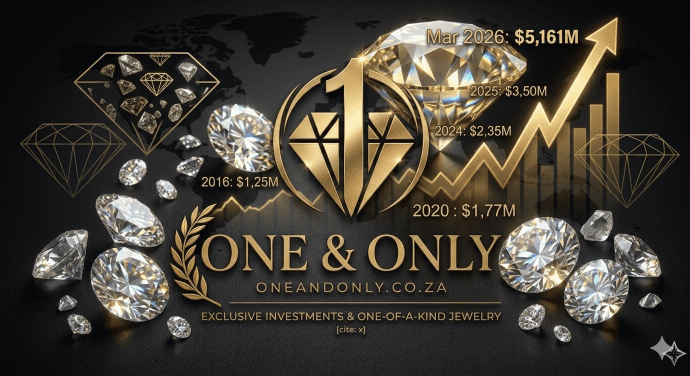
With gold prices reaching record highs of $5,161 per ounce in March 2026 due to Middle East tensions, investors are diversifying into other “hard assets”. Rare diamonds offer several unique advantages:
- Concentrated Wealth: A single pink diamond weighing only a few carats can be worth tens of millions of dollars, making it the most portable form of significant wealth on the planet.
- Low Correlation: The market for top-tier rare diamonds often moves independently of the stock market, providing a hedge against systemic financial collapse.
- Finite Supply: With major mines reaching the end of their lifespans, the supply of natural, earth-mined rare diamonds is strictly shrinking, creating a natural upward pressure on prices.
Market Outlook: The “Flight to Quality”
As geopolitical risks rise, the “flight to quality” isn’t just limited to gold. We are seeing a “new paradigm” where ultra-high-net-worth individuals are viewing rare diamonds as a long-term legacy asset. Unlike liquid stocks, these stones are “private” assets that can be held for generations.
Tips for Starting a Diamond Collection
- Insist on GIA Certification: Never purchase a collector-grade stone without a report from a leading lab like the Gemological Institute of America.
- Focus on Rarity Over Size: A smaller, “Fancy Vivid” colored diamond will almost always outperform a much larger stone of a common color.
- Consult Specialists: Brands like One & Only specialize in sourcing these one-of-a-kind jewelry pieces and investment stones that aren’t available to the general public.
At One & Only, we believe that in an uncertain world, the rarest treasures provide the most certain security.
The Pinnacle of Rarity: Recent Auction Records for Pink and Blue Diamonds
As we move through 2026, the market for rare collector diamonds has decoupled from the mainstream jewelry industry. While standard diamond prices have stabilized, the “ultra-rare” segment—specifically natural Pink and Blue diamonds—is shattering records, fueled by a shrinking global supply and a surge in “crisis-proof” investing.
Here is the current state of the market’s most elite assets.
Pink Diamonds: The “Argyle Effect” and Beyond
Since the closure of the Argyle mine in late 2020, the supply of high-quality pink diamonds has plummeted, leading to an average price increase of 398% over the last two decades. In 2025 and early 2026, we’ve seen a notable spike in “speculative investor buying.”
| Iconic Stone | Carat | Grade | Price (USD) | Date |
| Pink Star (CTF Pink) | 59.60 | Fancy Vivid Pink (IF) | $71.2 Million | Record Holder |
| Williamson Pink Star | 11.15 | Fancy Vivid Pink (IF) | $57.7 Million | Jan 2026 (Reported) |
| The Graff Pink | 23.88 | Fancy Intense Pink (IF) | $46 Million | Historical Record |
| The Glowing Rose | 10.08 | Fancy Vivid Pink | $20 Million (Est.) | Nov 2025 |
2026 Market Pulse: For 1-carat pink diamonds, the “benchmark” price has risen to approximately $570,000, with exceptional 25-carat stones now projected to exceed $36.5 million at auction.
Blue Diamonds: The Billionaire’s Hedge
Blue diamonds remain even more elusive than pinks, accounting for less than 0.02% of all diamonds found. Their prices are currently rising by roughly 7% annually as major sources like the Cullinan Mine in South Africa produce fewer high-quality “vivid” stones.
- The Price Per Carat Record: The Blue Moon of Josephine (12.03 cts) still holds the staggering record of over $4 million per carat.
- The “Mellon Blue” Paradox: In late 2025, the 9.51-carat Mellon Blue sold for $25.6 million. Interestingly, this was slightly less than its 2014 price, proving that while rarity is key, provenance and market timing are everything in the $20M+ bracket.
- New Discovery: In January 2026, a massive 41.82-carat blue rough was unearthed at the Cullinan Mine. Analysts estimate this single stone could be worth upwards of $40 million once cut and polished.
Why 2026 is the “Year of the Hard Asset”
The current geopolitical climate—specifically the instability in the Middle East—has pushed gold to $5,161/oz, but it has also triggered a “flight to quality” in the diamond world.
Collectors are shifting their focus toward:
- Type IIb Diamonds: These are chemically pure stones (mostly blues) that represent less than 0.1% of all natural diamonds.
- Traceability & Ethics: By 2026, a majority of luxury buyers now demand blockchain-verified proof of origin.
- “Desert Diamonds”: A new 2026 trend favoring warm honey and champagne tones is emerging as a more “accessible” alternative to the multi-million dollar Vivid Pinks.
Final Investment Thought
In the 2026 “New Paradigm,” rare diamonds are no longer just jewelry; they are portable, private equity. As mining output in Botswana and South Africa matures and ore grades decline, the “scarcity premium” for these stones is only expected to widen.